


G-Union
News
Aug 12, 2026
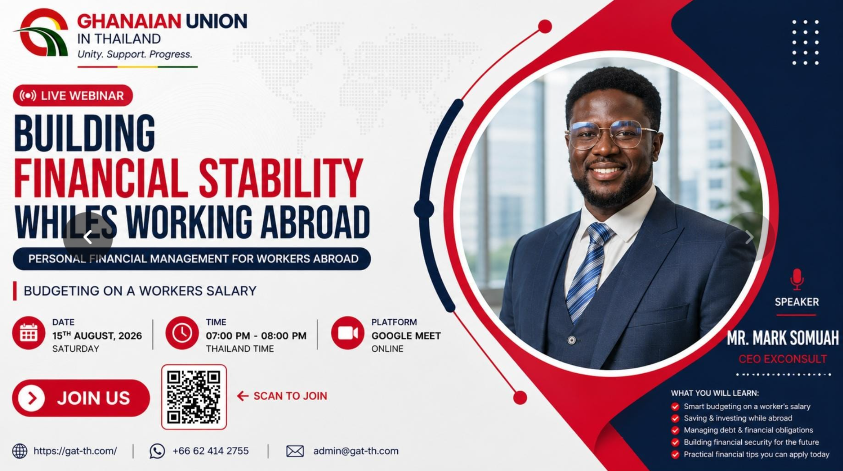
The Ghanaian Union in Thailand (G-Union) will host a live financial education webinar on Saturday, 15 August 2026, from 7:00 p.m. to 8:00 p.m. Thailand time, focusing on how people working abroad can build stronger financial foundations while managing the demands of everyday life. Titled “Building Financial Stability Whiles Working Abroad,” the Google Meet session will feature Mr. Mark Somuah, CEO of Exconsult, and will address personal financial management, particularly budgeting on a worker’s salary.
The programme comes at a relevant time for migrant and international workers who must often balance living expenses in their host countries with savings, investment, debt obligations and financial commitments to families at home.
The urgency of financial education has increased as households navigate cost-of-living pressures, debt and increasingly complex financial products. The OECD’s Consumer Finance Risk Monitor 2026 identifies cost-of-living pressures, scams and fraud, low financial literacy and high debt among risks threatening consumers’ financial well-being. The OECD also stresses that financial literacy involves the knowledge, skills, attitudes and behaviours required to make informed financial decisions, and recommends education tailored to groups including immigrants and lower-income populations. These challenges make practical discussions about budgeting, saving and responsible financial planning particularly relevant for Ghanaians earning their income outside their home country.
For participants, the webinar is expected to concentrate on practical financial habits that can be applied to regular employment income. According to the event programme, the learning areas include smart budgeting on a worker’s salary, saving and investing while abroad, managing debt and financial obligations, building long-term financial security, and applying practical financial tips immediately. International research supports the importance of such targeted education: the OECD notes that migrants and their families can face barriers to accessing and effectively using appropriate financial products, making financial education an important element of strengthening their financial resilience.
Thailand has also taken institutional steps to promote financial well-being among workers. An OECD policy handbook records that the Bank of Thailand launched its workplace financial-education programme “Fin. Dee Happy Life!!!” with the objective of encouraging employees to establish emergency funds, save regularly and reduce debt; by May 2021, the programme had trained 300 trainers across 97 government and private organisations.
Separately, Thailand’s Ministry of Labour maintains a fund designed to support workers through savings cooperatives, with stated objectives that include helping workers address informal debt and strengthening the economic security and quality of life of workers and their families. While these government initiatives are separate from the G-Union webinar, they demonstrate the broader policy importance attached to workers’ financial security.
Expert evidence similarly shows that financial stability depends on more than simply earning a salary. OECD guidance links financial education with controlling expenditure and debt, developing disciplined saving habits, making better-informed investment decisions and preparing for longer-term needs such as retirement. For workers abroad, these skills can become especially important because income may need to cover expenses across more than one country or household.
The OECD’s research on migrants and their families also highlights the importance of remittances and the particular financial vulnerabilities that migrants can encounter. Against that background, the G-Union webinar provides an opportunity to translate broad financial principles into practical strategies relevant to workers living overseas.
The Ghanaian Union in Thailand’s 15 August webinar therefore represents more than a discussion about monthly budgeting; it places financial knowledge within the wider goal of helping community members pursue greater stability and long-term economic resilience. Participants can join the one-hour session through Google Meet, using the joining information and QR code provided on the official event poster.
By bringing budgeting, saving, investment, debt
management and future financial security into one focused conversation, the
programme reinforces a central message for workers abroad: earning income is
only one part of financial progress—managing that income deliberately is
essential to turning employment abroad into lasting financial security.
Click the link to Join on the 15th August, 2026. Join Meeting Here.