


G-Union
News
Aug 20, 2026
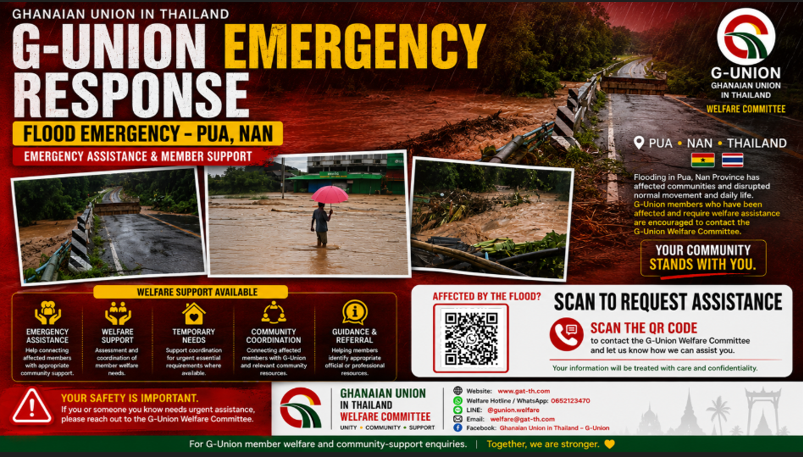
PUA, NAN, THAILAND — The Ghanaian Union in Thailand (G-Union) has activated its community emergency-response and welfare-support mechanism for members affected by flooding in Pua District, Nan Province, urging anyone requiring assistance to contact the union’s Welfare Committee. The emergency campaign, announced through the G-Union Welfare Committee, offers support in areas including emergency assistance, welfare coordination, temporary-needs support, community coordination, and guidance and referral. The action comes amid heightened flood concerns across northern Thailand, where heavy rainfall has pushed water levels higher and increased the danger of flash flooding, run-off and disruption to communities. Recent reporting confirms that Nan has been among the northern provinces under intensified water monitoring following heavy rainfall.
The situation carries particular urgency for residents and foreign nationals living in vulnerable communities. Thailand's water authorities have warned that accumulated rainfall can trigger flash floods, forest run-off, landslides and waterlogging, especially in low-lying areas and communities near waterways and foothills. Nan was specifically identified among provinces facing very heavy rainfall risks in early August, while rising water levels in parts of the Nan River subsequently prompted 24-hour monitoring. Such conditions can affect road access, housing, transportation, employment and the ability of residents to obtain essential supplies, making rapid communication between affected G-Union members and community welfare coordinators especially important.
Thailand's government has simultaneously strengthened its flood-response posture across the North. On August 10, the government announced a 24-hour operational response mechanism for northern flooding and drought, directing relevant agencies to work proactively and allowing provincial authorities greater flexibility to access emergency resources and assist people on the ground. Earlier instructions from the Ministry of Interior also called on the Department of Disaster Prevention and Mitigation, provincial governors, local authorities and other agencies to maintain preparedness, issue public warnings and ensure personnel and disaster-response equipment are available around the clock. Residents in risk areas have been advised to closely monitor official information and move belongings to higher ground when water levels threaten to become critical.
Disaster-management guidance underscores why early community coordination is important. Flood emergencies can develop rapidly when intense rainfall combines with saturated ground, steep terrain and rising waterways, leaving vulnerable residents with limited time to respond. Government assessments of northern and other flood-prone areas have repeatedly emphasized proactive water management, early warning, coordinated agencies and preparedness before an emergency escalates. Against that backdrop, G-Union's welfare initiative provides an additional community-level channel for affected Ghanaian members—not as a replacement for Thai emergency authorities, but as a mechanism to help members communicate their needs, obtain guidance and connect with appropriate community or official resources where necessary.
The Ghanaian Union in Thailand Welfare Committee is therefore encouraging members affected by the Pua, Nan flooding to request assistance through the contact channels and QR code provided on the official emergency poster. Members facing immediate danger should prioritize instructions from Thai authorities and local emergency services, while keeping the union informed where community support is required. As northern Thailand continues through a period of heightened weather and flood risk, timely reporting, reliable information and coordinated action remain essential to protecting lives and reducing disruption. G-Union's message to affected members is clear: “Your community stands with you” — reinforcing the principle that in times of emergency, unity, preparedness and collective support can make a critical difference.